The Folding Table Is the Label: Britain’s Car-Boot Demo Scene Is Doing A&R by Hand
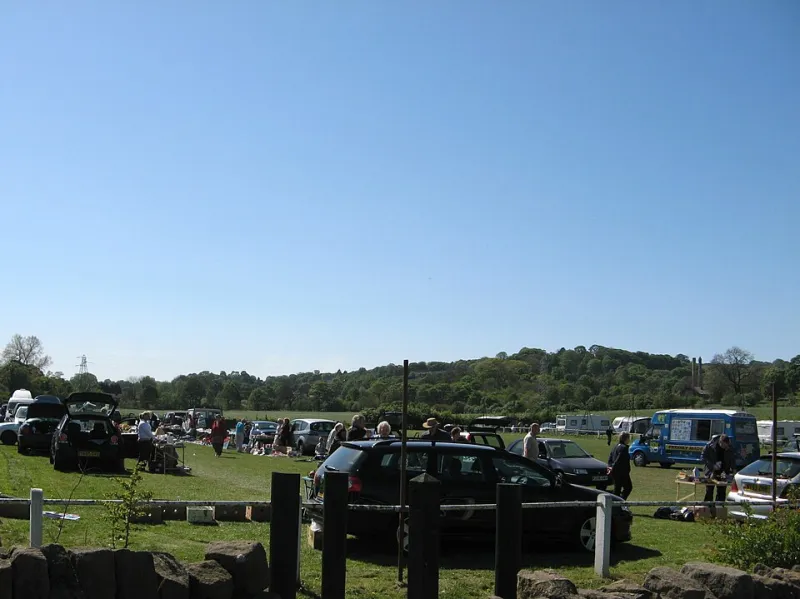
Photo: Stephen Armstrong , CC BY-SA 2.0, via Wikimedia Commons
At 7:40 on a Sunday morning, a leisure-centre car park in the Midlands is already half full. The first tables are up: a crate of mismatched crockery, a hedge trimmer with no price, a box of children’s DVDs. And then, between a lamp base and a stack of Tupperware, a handwritten sign: DEMO TAPES £4 / CDS £3 / ASK ME ABOUT THE GIG.
This is not a novelty stall. It is one of dozens of small, unglamorous music desks that appear across Britain each weekend. Unsigned artists are using car-boot sales as a distribution channel, a feedback loop and a place to practise the oldest skill in the business: talking to someone who has no obligation to be polite. No pitch deck. No monthly listeners. Just a folding table and whoever stops.
The table is the shopfront
Nadia, 24, sold thirty-one copies of her synth-pop EP at a car boot in Leicestershire last month. The stall cost £12. The tapes cost about £1.20 each to make; the printed sleeves and cases added another 40p. She sold them for £5, or £8 with a tote bag she screen-printed in her kitchen. After petrol and a coffee, she cleared about £90. Not a living. But not nothing.
‘Thirty copies isn’t a market,’ she says. ‘It’s a room. And I know more about that room than I know about my streaming dashboard.’
That distinction matters. A streaming platform tells you where a listener skipped. A car-boot buyer tells you why. They might say the second track is too long, or that the vocal gets lost under the drums, or that they bought it because it reminded them of a band they saw in 1987. They might also say nothing and hand over a fiver. Both are useful.
The economics are deliberately small. A table, a float, a thermos. A Bluetooth speaker playing at a volume that does not annoy the stall selling bird feeders. A QR code taped to the table that leads to a mailing list, not just a streaming link. Sellers talk about ‘the thirty-copy rule’: if you can shift thirty physical copies in a morning, you have proof that thirty people will leave the house for you. That is not a strategy for global domination. It is a strategy for being real.
What analytics cannot hear
The car-boot scene is not a talent contest. Nobody is handing out record deals between the pasting tables. But it is doing some of the work that A&R used to do before it became a job title attached to a spreadsheet: listening in public, noticing who connects, and following a hunch.
Tom, who runs a small cassette label in Sheffield and sells at boots across South Yorkshire, calls it ‘slow A&R’. ‘You see the same faces,’ he says. ‘Someone buys a tape, then comes back two months later and asks when the next one is out. That is a fan. That is better than a spike on a graph.’
The conversations are specific in a way that analytics rarely are. A buyer might mention a function room that hosts gigs, a community radio show that needs guests, a record shop that takes local stock on consignment. One seller I spoke to got a support slot because a man buying a chest of drawers recognised her from a previous stall. Another was asked to play a wedding. The car boot does not care about your genre tags. It cares whether you can hold a conversation while someone else is haggling over a lawnmower.
There is also the matter of the object. A burned CD with a stamped sleeve, a tape with a handwritten label, a QR code that leads to a demo folder: these are small acts of faith. They cost money and time, and they ask the buyer to do something other than press play. That friction is the point. It makes the exchange memorable. In a week when every song is available everywhere, a Sunday-morning tape is a commitment.
The rules of the folding table
The etiquette is unwritten but strict. Do not hard-sell. Let people pick things up. Price clearly. Bring change. Play one track, not a whole album. If someone says they do not have a CD player, offer the QR code. If someone says they used to be in a band, listen. The car boot is a social space before it is a shop.
That is why the scene feels less like marketing and more like local infrastructure. It is a place where a musician can test a song title, a sleeve design, a joke, a handshake. It is also a place where the distinction between artist and audience gets pleasantly blurry. The person selling you a demo might also buy a chair from you. The person buying the demo might run a night in the next town. Nobody is too important to carry their own boxes.
In 2026, the algorithm is more efficient than ever. That is exactly why the folding table still works. It is inefficient on purpose. It is slow, damp and slightly chaotic. It produces thirty copies, a handful of conversations and maybe one useful phone number. For a lot of Britain’s independent musicians, that is enough to keep going.
The car boot is not the future of the music industry. It is something better: a small, human-sized side door into it. And on a Sunday morning, with a thermos going cold and a lamp base wobbling in the wind, that side door is open.