The Joystick Knows Your Name: Britain’s Micro-Arcades Are Building for the Street Outside
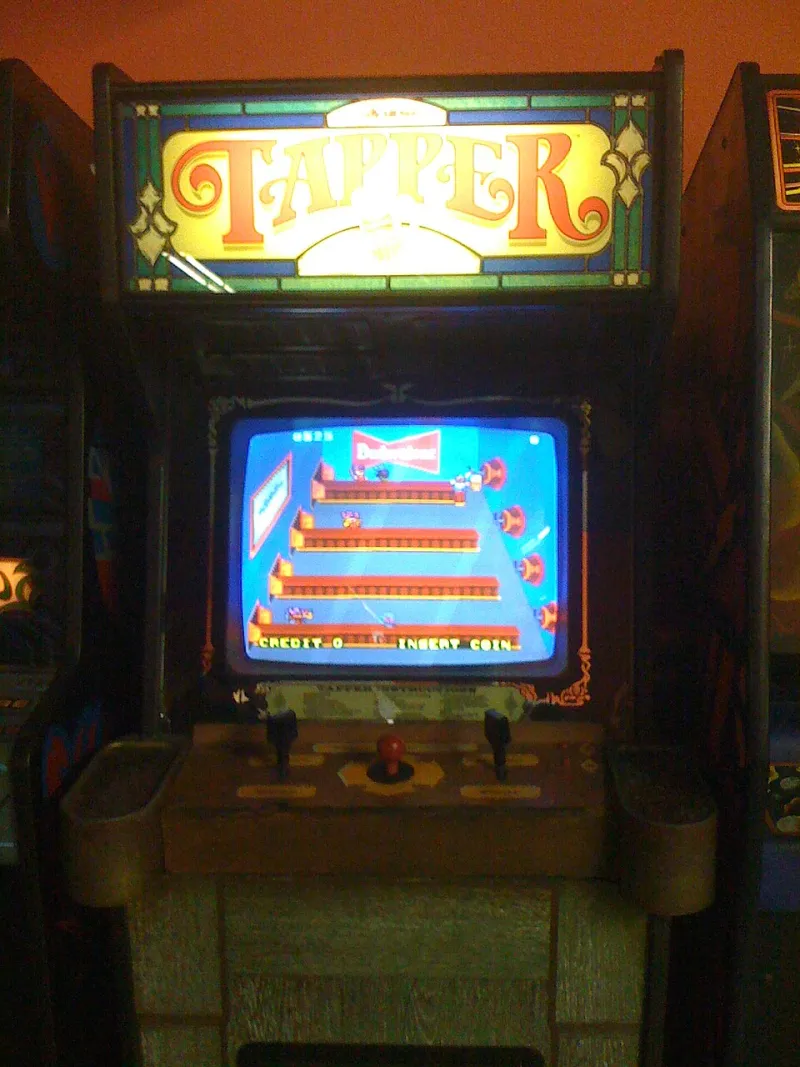
Photo: Rob DiCaterino from Jersey City, NJ, USA, CC BY 2.0, via Wikimedia Commons
There is a chip shop on the edge of a Yorkshire town where the queue has started moving sideways. Not out of the door and into the street, but along the wall, past the salt and vinegar, towards a plywood cabinet with a scratched-up screen and a single joystick that has clearly been repaired at least twice. The game on it involves catching seagulls before they get to your chips. The high score table has nine entries and seven of them are first names. Nobody has come from London to put it there. It was built in a garage four streets away.
This is the shape of a scene that doesn’t have a name yet, mostly because nobody in it is trying to give it one. Across the UK — in pub back rooms, community centres, libraries, youth clubs, record shop basements and the occasional chip shop — people are building small arcade machines and putting local games in them. Not retro cabinets playing the classics. New cabinets, new games, made for the specific street they stand on.
A cabinet with a postcode
The tell is the high score table. Where a commercial arcade machine asks for three letters — ASS, DAD, CPU — the micro-arcade asks for a name, and gets one. Sometimes it asks for a street. On a machine in a community centre in Splott, the top score is held by someone called Marley, and the second is held by someone called Marley’s Nan. That’s not a leaderboard. That’s a parish noticeboard with a fire button.
The games themselves are almost aggressively local. A bus-route time trial through a fictionalised version of a real high street. A one-button game about getting your washing in before the rain, set in a specific back garden. A two-player tug-of-war over the last parking space outside a school. None of these would survive five minutes in an app store, because none of them are trying to. Their audience is, at most, a few thousand people, and their feedback loop is someone saying “that’s rubbish” to your face in the Co-op.
That constraint is the whole point. It changes the design. You can’t rely on analytics, so you watch. You can’t tune for a hypothetical average player, so you tune for a nine-year-old and a seventy-year-old standing at the same cabinet, taking turns, arguing. You can’t patch out a problem on a Tuesday afternoon from a laptop in another city, so you learn to make the thing right the first time, or you learn to accept that it’s a bit wrong and everyone’s fine with that.
MDF, a Raspberry Pi and a 20p mech
The build scene is unglamorous in the best way. Most cabinets start as MDF, cut in a shed or a men’s shed or a makerspace, screwed and glued and painted by someone who has watched three YouTube videos and decided they could do better. The electronics are usually a Raspberry Pi or an old small-form PC, a USB encoder board, and whatever joystick and buttons the builder could afford that month. Pimoroni in Sheffield and The Pi Hut will sell you most of it. Arcade World UK will sell you the rest, including the coin mech that makes the noise everyone actually wants.
And that noise matters more than it should. A cabinet that takes 20p is a different object from a cabinet that takes nothing. The coin mech turns a screen into a fixture. It gives the whole thing a small, legible economy: a float in a tin, a key held by whoever runs the room, a decision every few months about whether to spend the takings on a new button or a new kettle. Nobody is getting rich. Several people are getting a reasonably good Saturday out of it.
Some machines are free to play with a donations jar taped to the side. That’s fine too, and arguably better for a youth club. But the 20p version does something the free version can’t, which is give a kid a reason to stand there for forty minutes working out whether they’ve got another go in them. It’s a very small form of agency. It’s also, quietly, a form of loitering with permission — which is not something British public space offers teenagers very often any more.
Designing for people you’ll see again
The interesting design work is happening at the edges of difficulty. A game built for a global audience is tuned to keep a stranger playing for as long as possible. A game built for a specific room has to be tuned to keep a nine-year-old and a retired bus driver both entertained, in public, without either of them feeling mugged. That’s a harder brief than it sounds, and it produces strange, generous design choices: gentle first levels, brutal secret levels, scores that reset weekly, a “hard mode” that’s just the same game with the wind turned up.
There’s also a physicality to the feedback that the app stores can’t replicate. A joystick that’s slightly too stiff gets mentioned. A button that sticks gets fixed with a screwdriver borrowed from behind the bar. A game that’s too hard gets a post-it note on the bezel reading “TOO HARD M8” and, three weeks later, a new version. Nobody writes a changelog. The changelog is the room.
The UK already has its big arcades — Arcade Club’s hangars in Bury and Leeds, the National Videogame Museum in Sheffield — and they’ve shown that there’s real appetite for cabinets as a day out. The micro-arcade scene is the other end of that: not a destination, just a thing on the way to somewhere else. A cabinet in a launderette. A cabinet in a library that shares a wall with the photocopier. The point isn’t the pilgrimage. The point is that it’s there on a Tuesday.
What the street actually wants
The honest answer is that nobody knows yet, and that’s part of the charm. Some of these projects will quietly stop. The cabinet will end up in a garage, or get donated to a school, or get stripped for parts. Others will become a fixture, and a decade from now there’ll be a generation of people in one town who all remember the same bug in the same game and can hum the same three-second loop.
That’s the thing the global platforms can’t sell you. A game made for everyone is, by design, made for no one in particular. A game made for the street outside is a piece of local culture with a coin slot, and it belongs to the people who put their 20p in. The joystick knows your name because someone bothered to type it in. That’s not a small thing. In a country where so much of the fun has been centralised, curated and pushed through an algorithm, a slightly wonky cabinet in a chip shop is a quietly radical bit of infrastructure.
Insert coin. Insert postcode. See who turns up.